
Business objective
Increase qualified Expert Home Service bookings by using Google Ads and SEO to capture high-intent curtain and blind demand, improve conversion quality, and make search a larger contributor to monthly EHS growth.
When Griffith Foods wanted to mark its 100-year legacy and strengthen its digital footprint in India and the Middle East, they partnered with Let’s Talk Communication. Our role was to launch their regional social media presence, craft compelling content, and develop email campaigns that communicated both innovation and sustainability.
Executive summary
The Yellow Dwelling entered the programme with strong consumer interest but inconsistent conversion into Expert Home Service bookings. Website traffic was substantial, yet EHS conversion fluctuated sharply, and paid and organic Google Search together contributed only 43 last-touch leads in November 2025.
By May 2026, the business had built a much stronger search contribution. Total EHS orders reached 505, Google Ads last-touch leads rose to 121, organic search leads reached 28, and search’s share of total EHS volume increased from 15.7% to 29.5%.
+84% TOTAL EHS ORDERS 274 in Nov → 505 in May | +317% GOOGLE ADS LEADS 29 → 121, last-touch basis |
+100% ORGANIC SEARCH LEADS 14 → 28, last-touch basis | +13.8 pp SEARCH SHARE 15.7% → 29.5% of EHS orders |
The headline result
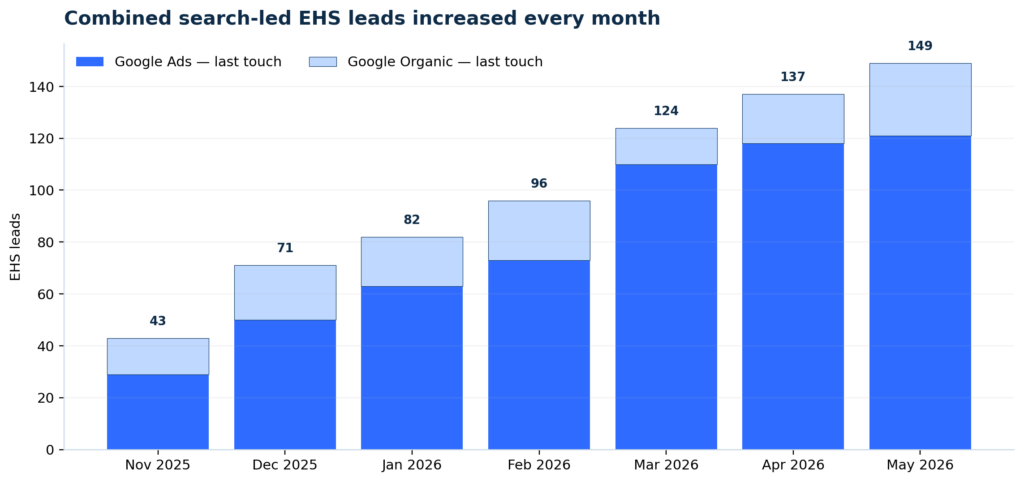
Paid and organic Google Search grew from 43 to 149 monthly last-touch EHS leads — a 247% increase. Search-led leads increased every month across the seven-month period, even when total EHS volume temporarily softened.
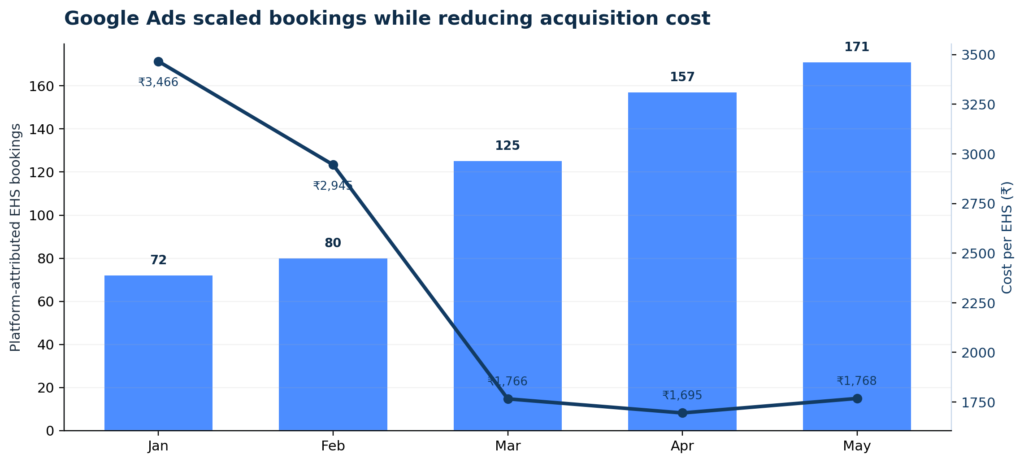
Google Ads also became materially more efficient on the platform-attributed view: from January to May 2026, bookings increased by 138% while spend rose by only 21%, reducing cost per EHS from ₹3,466 to ₹1,768.
Where they were
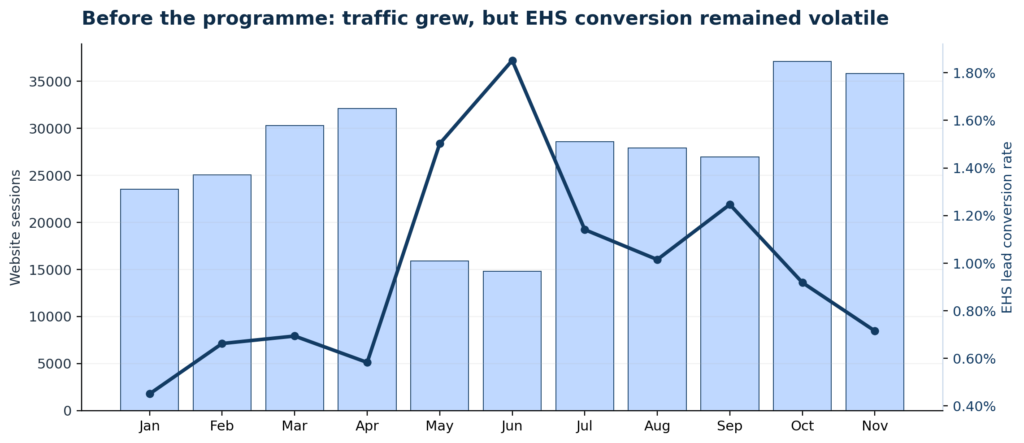
The starting challenge was not a lack of traffic. The core issue was that traffic growth did not translate proportionately into Expert Home Service bookings.
| What the initial data showed Across January–November 2025, EHS lead conversion ranged from approximately 0.45% to 1.85%. In October the site generated 37,129 sessions and 341 leads; in November, traffic remained high at 35,808 sessions but leads fell to 256, reducing conversion to roughly 0.71%. |
BASELINE
The starting point in November 2025
Total EHS orders | Google Ads LT | Organic LT | Combined search | Search share |
274 | 29 | 14 | 43 | 15.7% |
| Core diagnosis Intent mismatch, mixed conversion signals, underdeveloped EHS reassurance, and insufficient service- and location-led organic visibility were limiting the value of existing demand. |
The search-led strategy
The programme combined immediate paid-search demand capture with a longer-term organic and local search framework. The strategy was designed to make Google useful at every stage — from the customer’s first question to the final EHS booking.
01 Fix measurement and attribution Separate EHS bookings from product purchases, distinguish primary and secondary actions, and create cleaner bidding signals. | 02 Capture high-intent paid search Prioritise curtain consultation, measurement, customisation, installation, blinds and city-specific service intent. |
03 Improve campaign structure Reduce overlap, organise campaigns around intent and location, and scale automation only after conversion signals are reliable. | 04 Build organic decision support Develop city, room and function pages; improve internal linking, metadata, answer blocks and service visibility. |
05 Strengthen the EHS journey Use clearer service positioning, price and process reassurance, proof, FAQs and direct booking paths. | 06 Scale city by city Concentrate budgets on proven markets, then expand only where cost and booking-quality benchmarks are met. |
| Strategic principle Search should not merely bring people to a curtain catalogue. It should move uncertain customers closer to expert help — and make the EHS booking the natural next step. |
How the channels worked together
Channel | Role | Primary outcome |
Google Ads | Capture immediate, high-intent demand | EHS bookings now |
Organic Search | Answer comparison, local and decision queries | Compounding qualified traffic |
City / service pages | Match location and consultation intent | Higher relevance and conversion |
Month-on-month customer journey
Month | Google Ads | Organic | Combined | Combined MoM | Search share |
Nov 2025 | 29 | 14 | 43 | — | 15.7% |
Dec 2025 | 50 | 21 | 71 | 65.1% | 18.9% |
Jan 2026 | 63 | 19 | 82 | 15.5% | 24.7% |
Feb 2026 | 73 | 23 | 96 | 17.1% | 26.4% |
Mar 2026 | 110 | 14 | 124 | 29.2% | 25.9% |
Apr 2026 | 118 | 19 | 137 | 10.5% | 29.3% |
May 2026 | 121 | 28 | 149 | 8.8% | 29.5% |
| A more resilient acquisition mix Combined search leads rose every month. When total EHS orders fell in January and April, search-led leads still grew 15.5% and 10.5%. Overall, search generated 106 of the 231 additional monthly EHS orders (46%). |
Google Ads: scale with efficiency
Month | Google EHS | Spend | Cost / EHS |
Jan 2026 | 72 | ₹249,559 | ₹3,466 |
Feb 2026 | 80 | ₹235,603 | ₹2,945 |
Mar 2026 | 125 | ₹220,795 | ₹1,766 |
Apr 2026 | 157 | ₹266,053 | ₹1,695 |
May 2026 | 171 | ₹302,263 | ₹1,768 |
What the efficiency gain means
| Why this matters From January to May, booking volume grew more than six times faster than spend. This indicates stronger demand capture and conversion efficiency rather than a simple budget-led increase. |
01 Scale became more economical The account generated 99 additional platform-attributed monthly EHS bookings while cost per booking fell by almost half. | 02 Efficiency held at higher volume Cost per EHS remained below ₹1,800 across March, April and May even as booking volume continued rising. |
03 The signal is ready to deepen The next optimisation step is to distinguish booked, completed and revenue-generating home visits. | 04 Attribution needs alignment Platform and customer-journey numbers should be read together, not directly equated, because their attribution methods differ. |
05 Budget can follow proven intent Future expansion should prioritise the city and query clusters that maintain booking quality and downstream revenue. | 06 Revenue becomes the next North Star Once offline outcomes are connected, bidding can move from raw booking volume towards qualified visit and order value. |
Organic search and the wider customer journey
ORGANIC IMPACT
Organic search doubled its monthly closing contribution
Google Organic last-touch EHS leads increased from 14 in November to 28 in May — a 100% increase. Although organic performance was more volatile than paid search, it recovered strongly in April and May, with May recording the highest organic closing volume in the period.
| A useful interpretation Organic growth should be judged through both monthly lead volume and a rolling average. At this stage, small numerical changes create large percentage swings, but the direction from March to May was clearly positive: 14 → 19 → 28 leads. |
CUSTOMER JOURNEY
Google was also an important first touch
May 2026 | First touch | Last touch |
Google Ads | 144 | 121 |
Google Organic | 32 | 28 |
This difference shows that last-touch reporting captures only the final recorded interaction. In May, Google Ads initiated 144 customer journeys but closed 121 on a last-touch basis; organic initiated 32 and closed 28. Some customers discovered the brand through Google and later returned through direct traffic, social, remarketing or another source before ordering.
| The practical takeaway Google was doing two jobs: introducing customers to The Yellow Dwelling and directly closing EHS orders. The real contribution of search is therefore broader than last-touch figures alone. |
Where they are now
TRANSFORMATION SNAPSHOT
Before vs now
Metric | Starting point | Current point | Change |
Total monthly EHS orders | 274 — Nov 2025 | 505 — May 2026 | +84% |
Google Ads last-touch leads | 29 | 121 | +317% |
Google Organic last-touch leads | 14 | 28 | +100% |
Combined search leads | 43 | 149 | +247% |
Search share of EHS orders | 15.7% | 29.5% | +13.8 pp |
Google Ads cost per EHS* | ₹3,466 — Jan | ₹1,768 — May | −49% |
*Cost per EHS is based on the Google Ads platform performance view. All other search-lead metrics above are based on the final recorded customer touchpoint.
BUSINESS IMPACT
What changed in the business
- Search evolved from a relatively small closing channel into a contributor to nearly three in every ten monthly EHS orders.
- Paid search became capable of scaling volume while materially lowering acquisition cost.
- Organic search began to add a growing, non-media-dependent layer of EHS demand.
- The channel mix became more resilient: search-led orders continued growing even in months when total EHS volume declined.
- The data now provides a clearer basis for city expansion, landing-page optimisation and revenue-based bidding.
| Case study conclusion The Yellow Dwelling did not simply increase EHS bookings. It built a more measurable, efficient and repeatable search-led acquisition engine — one that can now be scaled by city, intent and customer value. |
The next phase
The first phase proved that qualified search demand exists and that improved capture can materially increase EHS bookings. The next phase should move optimisation deeper into the commercial funnel.
01 Optimise to completed visits Import completed consultation status so campaigns learn from real service delivery, not only online booking confirmation. | 02 Connect EHS to revenue Track quotation value, order conversion and final furnishing revenue generated after each home visit. |
03 Scale proven search themes Expand high-intent service, customisation and city terms while protecting query quality and cost benchmarks. | 04 Strengthen city SEO Build differentiated city and area pages with local proof, coverage, FAQs, reviews and direct booking routes. |
05 Improve landing-page conversion Clarify what the visit includes, pricing, process, expertise, samples, timelines and post-visit steps. | 06 Use value-based bidding Once downstream data is reliable, optimise towards qualified visits and final order value rather than raw booking volume. |
| Recommended North Star EHS-generated revenue = qualified search traffic × booking conversion × visit completion × quotation acceptance × average order value. |
MEASUREMENT
Success metrics for the next reporting cycle
Metric | Why it matters |
Cost per completed home visit | Separates bookings from operationally fulfilled consultations |
Show / completion rate | Measures lead quality and follow-up effectiveness |
Quotation rate | Shows whether consultations progress commercially |
EHS-to-order conversion | Connects service demand to final furnishing sales |
Revenue per EHS booking | Enables value-based budget allocation |
Methodology and data notes
SCOPE
Data sources
- Initial Search-Led Strategy deck and baseline EHS consumer-behaviour analysis.
- EHS Customer Journey Report covering November 2025 to May 2026.
- Google Ads month-on-month EHS performance summary covering January to May 2026.
IMPORTANT
Attribution definitions
- Google Ads last-touch: the final recorded customer touchpoint was Google Paid; for April and May, Google-related last touches with UTM medium ‘cpc’ were classified as paid.
- Google Organic last-touch: the final recorded customer touchpoint was Google Organic; for April and May, Google-related last touches without ‘cpc’, including explicit Google organic sources, were classified as organic.
- First touch: the first recorded channel in the customer journey. Last touch: the final recorded channel immediately before the EHS order.
- Google Ads platform results use the platform’s own conversion attribution settings and therefore should not be expected to equal customer-journey last-touch totals.
TRANSPARENCY
Data-quality note
The May raw journey sheet contains 505 total orders and 397 attributed orders, while the workbook overview displays 504 and 396. The additional row is an unknown-source attributed order and does not change the Google Ads or Google Organic counts used in this case study.
| Reporting principle All growth claims in this document are based on completed monthly data through May 2026. Projected June figures were intentionally excluded from the headline case study results. |
THE YELLOW DWELLING
Search-led growth, built on stronger intent, measurement and conversion.